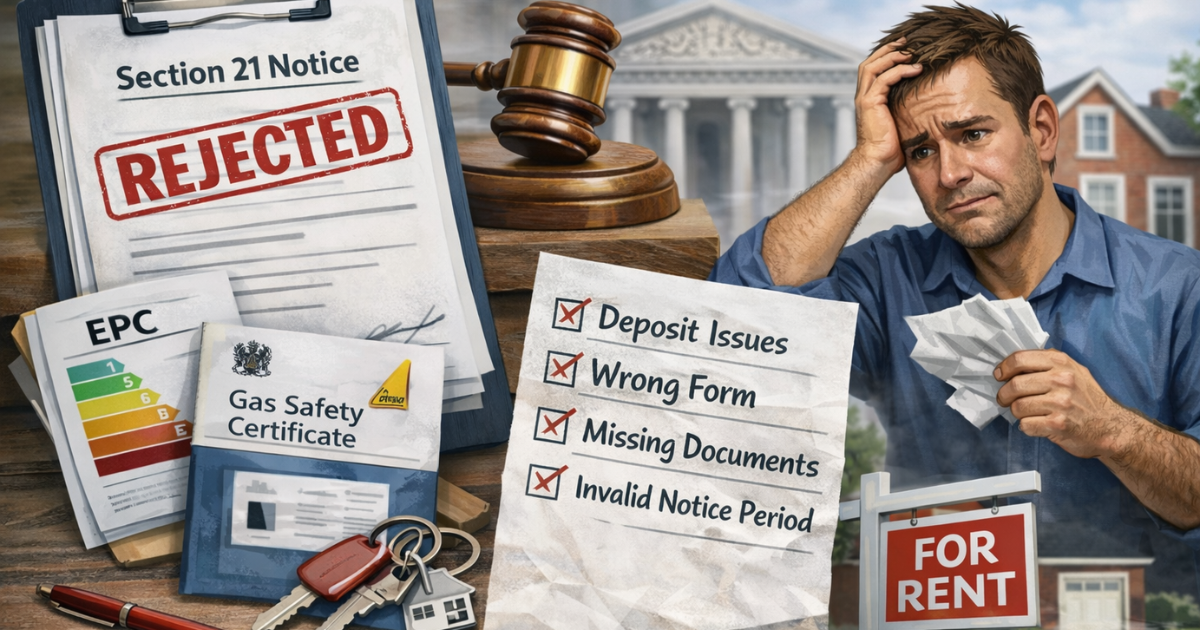

7) Letting the notice “go stale” before you start court action
A Section 21 notice has a shelf-life. If you don’t start possession proceedings in time, you may need to serve a fresh notice and start over.
Form 6A notes spell this out clearly:
- Where the tenant is entitled to the statutory 2 months’ notice, the notice can be relied on for 6 months from the day it’s given
- If a longer notice period applies (contractual periodic), the notice can be relied on for 4 months from the date after which possession is required.
Quick fix: Put a calendar reminder in your diary the day you serve it: “Court deadline: [date]”. Don’t rely on memory.
8) Deposit not protected within 30 days (or not protected at the time you serve)
Deposit compliance is a big one. A Section 21 notice can be invalid if:
- The deposit wasn’t protected within the usual 30 days,
- The deposit isn’t currently protected when you serve the notice, or
- You didn’t give all the prescribed information to the tenant (and any relevant person)
Quick fix: Before you even think about serving:
- Confirm the deposit is protected,
- Confirm that the prescribed information was served correctly, and
- Keep the proof in your “tenancy compliance pack.”
9) Missing prescribed documents: EPC
You can’t use Section 21 if you haven’t given the tenant a copy of the property’s Energy Performance Certificate (EPC).
Quick fix: Keep a dated email trail (or signed acknowledgement) showing the EPC was provided. Print it. File it.
10) Missing prescribed documents: Gas Safety Certificate
If gas is installed, you must provide a current gas safety certificate.
Quick fix: Store:
- the certificates, and
- proof the tenant received them (email trail is ideal)

11) Missing prescribed documents: “How to Rent” guide
You can’t use Section 21 if you haven’t given the tenant the government’s “How to rent” guide. GOV.UK is explicit that tenants must have been given it (and the gas safety certificate) before they moved in.
Quick fix: Email it at tenancy start; keep the sent email (and any attachments or links). If the tenancy is renewed and the guide has been updated, provide the new version.
12) Ignoring the “blockers”: fees, licensing, and council enforcement
This is the bucket that catches landlords out when everything else looks fine.
A) You took a banned fee (or kept a holding deposit unlawfully)
Under the Tenant Fees Act 2019, you can’t serve a Section 21 notice while any prohibited payment or unlawfully retained holding deposit hasn’t been repaid.
Quick fix: Repay first, then serve.
B) The property needs a licence, and you don’t have one (or haven’t applied)
If the property is an HMO requiring a licence (or in a selective licensing area) and you’re not licensed (or you haven’t applied), Section 21 can be blocked.
Quick fix: Get the licensing position confirmed with your local authority and keep evidence of your application if you’re in progress.
C) Retaliatory eviction rules after repair complaints
If a tenant complains about poor conditions and the council serves certain notices (like an improvement notice), a Section 21 can become invalid for a period (commonly discussed as 6 months).
Quick fix: Take repair complaints seriously, respond in writing, and keep a clear paper trail.
The “Pre-Flight” Section 21 Checklist (save this)
Before you serve, confirm you have:
- ✓ Form 6A completed correctly
- ✓ Tenancy started more than 4 months ago
- ✓ Fixed term ended or a valid break clause used
- ✓ Correct notice period (2+ months, longer if required)
- ✓ Deposit protected + prescribed information served
- ✓ EPC served
- ✓ Gas Safety certificate served (if applicable)
- ✓ “How to rent” guide served
- ✓ No banned fees / holding deposit issues outstanding
- ✓ Licensing in place (or valid application/exception)
- ✓ No council enforcement “blocker.”
- ✓ A solid proof-of-service plan (and evidence)
If you think you’ve already made a mistake…
Two practical options:
- Stop and re-serve correctly (often quicker than limping into court with a shaky notice)
- Get advice early if the situation is high-risk (e.g., rent arrears, vulnerable tenant, complex licensing). GOV.UK itself suggests getting legal advice if you’re unsure which notice to use.
What to do instead when Section 21 isn’t available
If Section 21 is blocked (or as we approach the 2026 changes), you may need to look to Section 8, which relies on specific grounds (such as rent arrears or breach). GOV.UK’s eviction guidance covers using Section 8 and notice periods depending on the ground.
Part One of this blog post can be found here
Friendly but important note
This is general information for landlords in England, not legal advice—eviction law is detail-heavy, and small facts can change outcomes. When in doubt, get proper advice before you do anything you can’t undo.